
Salvador Ferreira
Data Science graduate and AI & Data Analyst at Deloitte who builds the systems that make teams faster. Track record of turning manual, ad hoc processes into automated, repeatable workflows (10+ AI agents and automations in production) and turning raw data into dashboards and reports that leaders use to decide (50+ delivered). Comfortable translating ambiguous business problems into data requirements and technical solutions, and getting non-technical colleagues to actually adopt the tools. AI is part of how I work every day: I design agents and LLM workflows for teams, not just for personal productivity.
Areeiro
Correntes de Memória: replacement orders and payments agent
AI Engineer & Financial Controller · Jun 2025 – Present
Python · LLMs
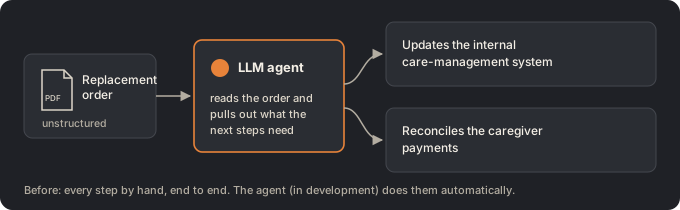
Developing an LLM-powered agent that reads unstructured caregiver-replacement orders (PDF), updates the internal care-management system and reconciles caregiver payments automatically, replacing an end-to-end manual process.
Every caregiver-replacement order arrives as an unstructured PDF. Until now each one went through the same manual process from end to end: someone read it, entered the change in the internal care-management system, and then reconciled the caregiver’s payments by hand.
The agent takes that over. It reads the order with an LLM, updates the care-management system and reconciles the payments on its own. I am building it in Python; it is one of the 10+ AI agents and automations I have built at Correntes de Memória, which together cut the team’s manual workload by about 6x.
Areeiro
Correntes de Memória: automations and financial operations
AI Engineer & Financial Controller · Jun 2025 – Present
Python · LLMs
- Built 10+ AI agents and automations (Python, LLMs) for repetitive operational tasks, cutting manual workload ~6x and freeing the team to focus on client retention and recurring revenue.
- Automating the shared service-quality tracking spreadsheet used by the care team, so quality data is captured consistently instead of by hand.
- Own day-to-day finance operations: 1,000+ invoices, receipts and payment confirmations recorded, verified and reconciled across accounts payable and receivable.
Amoreiras
Deloitte
AI & Data Analyst · Technology & Transformation (Financial Services) · Sep 2026 – Present
- Optimised multi-agent AI workflows, accelerating the team’s rate of delivery by ~10x.
- Built SQL and Python data transformations in dbt to support database migrations.
AI agent for migrating legacy data warehouses
I am developing an AI agent that automates the migration of legacy data warehouses, built on T-SQL stored procedures and SSIS packages, to a modern dbt architecture. The agent works as a multi-stage pipeline. First, it cleans the SQL code of comments and noise while preserving the business logic. Then it classifies each procedure by migration complexity and analyses its dependencies, execution paths and data transformations in depth. From that analysis, it generates synthetic test data without ever accessing real data. Finally, it produces and validates the dbt models in a medallion architecture and automatically fixes the errors it finds. To ensure security and traceability, it includes guardrails that control the commands it runs and record every action in an audit log. The goal is to drastically reduce the manual effort of migrations that typically involve hundreds of procedures, without losing rigour or quality.
Cidade Universitária
Iscte Junior Consulting
Analytics Consultant & Vice-President of the Fiscal Council · Oct 2023 – Jan 2025
- Built 50+ databases, dashboards and reports (Power BI, Excel) for client projects and internal teams, turning raw data into clear recommendations for decision-makers.
- Contributed to the organisation’s ISO 9001 certification (quality management and process standardisation) alongside the analytics department.
Parque das Nações
Happy Code Portugal
Programming Instructor · Jan 2025 – May 2025
Delivered Python, SQL and Excel training to learners aged 3–17, adapting technical content to very different levels of experience.
Campolide
NOVA IMS – Information Management School
MSc in Risk Management · 2026 – 2028 (expected)
Master’s programme on understanding, modelling and managing risk in complex settings, with a focus on the financial sector: credit, market and liquidity risk, financial derivatives, actuarial science, banking and insurance regulation, and machine learning and AI applied to risk management.
Cidade Universitária
ISCTE – University Institute of Lisbon
BSc in Data Science · 2023 – 2026
Three-year bachelor’s degree (180 ECTS) run by Iscte’s Business School and School of Technology and Architecture. It covers programming in Python, mathematics and statistics, databases and big data, supervised and unsupervised machine learning, deep learning, and data security, ethics and privacy, and ends with an applied project proposed by an outside organisation.
Marvila
LearnVestor
Personal Project - Financial Literacy App
Flutter (Dart) · PostgreSQL · Supabase · JavaScript
Learn investing through gamification with LearnVestor, a free app with no account needed. Track your virtual portfolio, complete lessons, and build financial literacy.
Ponte Vasco da Gama
Current Projects/Interests
Fun facts and niche topics
Currently trying to keep up with AI and trying new tools, open-source models and anything similar
Learning more about how to think more outside the box and be more critical and proactive
Building more side projects and investing more time inside the AI community to see what’s new
Watching car documentaries (Especially about JDM)
My photography page: https://www.instagram.com/palemistwhisper
Arco da Rua Augusta
This website
Personal project
Astro · React · Three.js · React Three Fiber · TypeScript · Python · GeoPandas · scikit-learn
A map of Lisbon you can fly over, with the places I have worked and studied lit up in it. Everything you see is drawn in the browser from open data: there are no photos or map tiles.
- The city. 79,000 building footprints from OpenStreetMap, raised to their height (from the number of floors where it is mapped). A Python pipeline (GeoPandas, Shapely) cleans them, cuts them to the area and packs the whole city, streets and parks into under 4 MB of compact binary files. Trees and green spaces come from the Câmara Municipal de Lisboa’s open data.
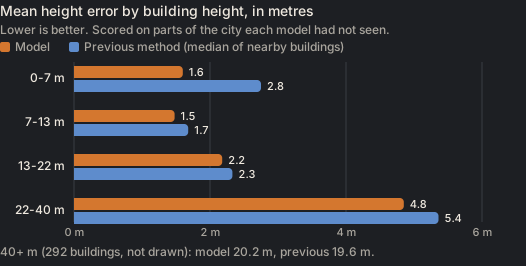
- Heights, learnt. About 70% of the buildings have no height or number of floors in OpenStreetMap. A gradient-boosted model (scikit-learn), trained on the 23,819 that do, predicts the rest from each building’s shape and kind and from its surroundings, rounded to whole floors. Tested on parts of the city it had not seen (spatial cross-validation, 600 m squares held out), it is off by 2.3 m on average, against 2.8 m for the rule it replaced (the median of the nearest mapped buildings), and puts 84% of buildings within one floor of their real height, against 78%. It helps most with low buildings; above 40 m both are about 20 m off (chart below).
- Drawing it. Astro serves a static page; the city is a React island using Three.js through React Three Fiber. Roofs, windows and shop fronts are made by shaders, not textures, and anything that repeats (trees, cars, lamps, people) is drawn as one instanced mesh.
- A city that lives. Cars follow the real streets and stop at the 2,294 traffic lights and 8,354 zebra crossings mapped in OpenStreetMap; buses run on 80 real bus lines; trains, trams and funiculars on their tracks.
- Light and weather. The sun’s position over Lisbon is worked out for the current minute, so the city follows the real day and night, and the weather is the real weather, from Open-Meteo.
- Running smoothly. Detail is drawn only near the camera, and the page lowers its own quality if a computer struggles to keep up.
Designed by me and built with Claude Code, an AI coding agent.
Lisbon